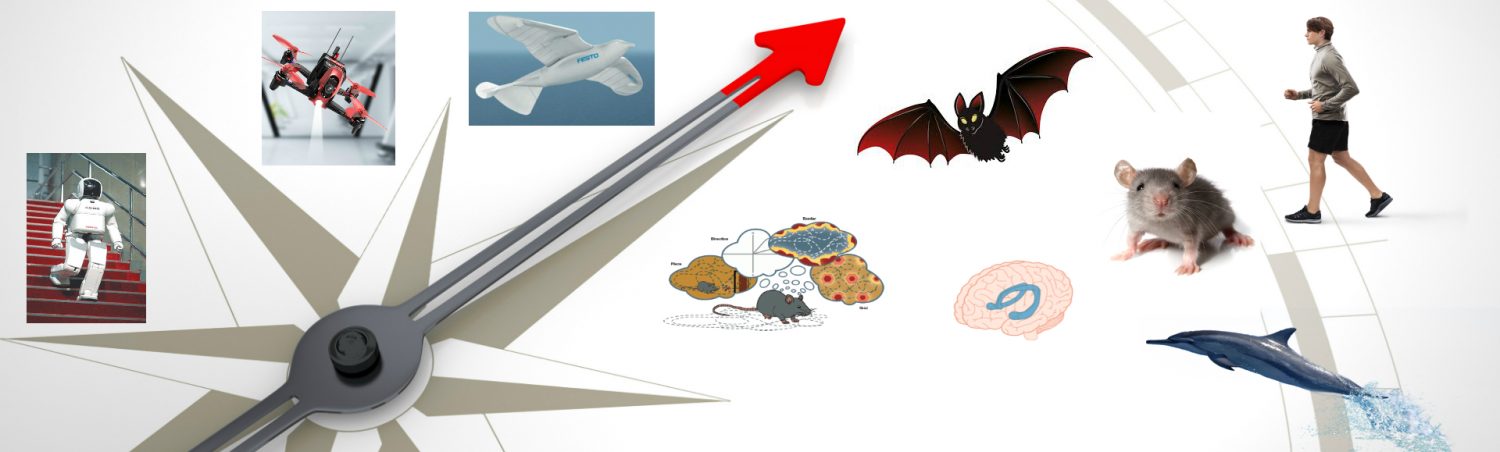
How does the brain’s “navigation circuit” operate in real-world conditions?
Palgi S., Ray S., Maimon S. R., Waserman Y., Ben-Ari L., Eliav T., Tuval A., Cohen C., Ali A. I., Keyyu J. D., Mouritsen H., Las L. & Ulanovsky N. Head-direction cells as a neural compass in bats navigating outdoors on a remote oceanic island. Science 390,eadw6202(2025).
Abstract
“Animals and humans rely on their navigation skills to survive. However, spatial neurons in the brain’s “navigation circuit” had not previously been studied under real-world conditions. We conducted an electrophysiological study of spatial neurons in the wild: We recorded head-direction cells from the presubiculum of bats flying unconstrained and navigating outdoors on a remote oceanic island. These neurons represented the bats’ orientation stably across the island’s entire geographical scale and irrespective of the dynamics of the Moon and the Milky Way. The directional tuning stabilized over several nights from the first exploration of the island. These results imply that head-direction cells can serve as a learned, reliable neural compass for real-world navigation—highlighting the power of taking neuroscience out into the wild.”
Palgi S., Ray S., Maimon S. R., Waserman Y., Ben-Ari L., Eliav T., Tuval A., Cohen C., Ali A. I., Keyyu J. D., Mouritsen H., Las L. & Ulanovsky N. Head-direction cells as a neural compass in bats navigating outdoors on a remote oceanic island. Science 390,eadw6202(2025).
About
Brain Inspired Navigation Blog
New discovery worth spreading on brain-inspired navigation in neurorobotics and neuroscience
Recent Posts
- How hippocampal brain-machine interface-based navigation reveals CA1 representations of intended actions?
- How to design a split attractor for rapidly writing a navigational goal?
- How traveling brain waves support flexible storage of human working memory?
- How to build bio-inspired whiskers enable tiny drones to navigate in darkness using touch?
- How to implement efficient robot navigation inspired by honeybee learning flights?
Tags
Categories
- 3D Movement
- 3D Navigation
- 3D Path Integration
- 3D Perception
- 3D SLAM
- 3D Spatial Representation
- AI Navigation
- Bio-Inspired Robotics
- Brain Inspired Localization
- Brain-Inspired Navigation
- Cognitive Map
- Cognitive Navigation
- Episodic Memory
- Excerpt Notes
- Flying Vehicle Navigation
- Goal Representation
- Insect Navigation
- Learning to Navigate
- Memory
- Neural Basis of Navigation
- Path Integration
- Path Planning
- Project
- Research Tips
- Robotic Vision
- Self-Flying Vehicles
- Semantic Memory
- Spatial Cognition
- Spatial Cognitive Computing
- Spatial Coordinate System
- Spatial Learning
- Spatial Memory
- Spatial Resoning
- Time
- Unclassified
- Visual Cortex
- Visual Cue Cells
Links
- Laboratory of Nachum Ulanovsky
- Jeffery Lab
- BatLab
- The NeuroBat Lab
- Taube Lab
- Laurens Group
- Romani Lab
- Moser Group
- O’Keefe Group
- DoellerLab
- MilfordRobotics Group
- The Space and Memory group
- Angelaki Lab
- Spatial Cognition Lab
- McNaughton Lab
- Conradt Group
- The Fiete Lab
- The Cacucci Lab
- The Burak Lab
- Knierim Lab
- Clark Spatial Navigation & Memory Lab
- Computational Memory Lab
- The Dombeck Lab
- Zugaro Lab
- Insect Robotics Group
- The Nagel Lab
- Basu Lab
- Spatial Perception and Memory lab
- The Neuroecology lab
- The Nagel Lab
- Neural Modeling and Interface Lab
- Memory and Navigation Circuits Group
- Neural Circuits and Memory Lab
- The lab of Arseny Finkelstein
- The Epstein Lab
- The Theoretical Neuroscience Lab
- Gu Lab (Spatial Navigation and Memory)
- Fisher Lab (Neural Circuits for Navigation)
- The Alexander Lab (Spatial Cognition and Memory)
- Harvey Lab (Neural Circuits for Navigation)
- Buzsáki Lab
- Brain Computation & Behavior Lab
- ……